Can You Speed Up Your Metabolism? What Actually Works
June 14, 2026
If you want to lose fat without starving, “speeding up your metabolism” sounds attractive. The problem is that most metabolism hacks burn fewer calories than people think.
Some strategies do help. Most are small. A few are basically noise.
The simple answer
Yes, you can increase how many calories you burn per day.
But most “metabolism boosters” are weak.
For fat loss and body composition, the methods that matter most are:
- Build and keep muscle
- Stay physically active
- Use cardio intelligently
- Avoid crash dieting
- Track your training and body weight consistently
The methods that matter least are:
- Green tea
- Sauna
- Cold plunges
- Eating more meals per day
- Trying to sweat more
That does not mean the small things are useless. It means they should not be your main plan.
What metabolism actually means
In gym terms, metabolism usually means total daily energy expenditure.
That is the number of calories your body burns per day.
It includes:
| Component | What it means |
|---|---|
| Resting metabolism | Calories burned just staying alive |
| Training | Lifting, cardio, sport |
| Daily movement | Walking, standing, fidgeting, chores |
| Digestion | Calories used to process food |
Two people can weigh the same and burn very different amounts of calories. Body size matters, but it is not the whole story. Daily movement, muscle mass, genetics, dieting history, job type, and training habits all change the number.
This is why calorie calculators are only estimates. Useful starting point, not truth.
What actually works
1. Building muscle
Muscle is metabolically active. It burns more calories than fat at rest.
The effect is real, but not magic. One extra pound of muscle does not suddenly let you eat a pizza every day. A useful estimate is that a pound of muscle burns around 6 calories per day at rest, while a pound of fat burns around 2 calories.
So if you gain 20–30 pounds of muscle over years, your resting burn may increase by roughly 80–180 calories per day. That is meaningful, but it takes time.
The bigger benefit is this:
More muscle usually means better training performance, higher work capacity, and a body that handles food better.
If your goal is a better metabolism, lifting is not optional. It is the foundation.

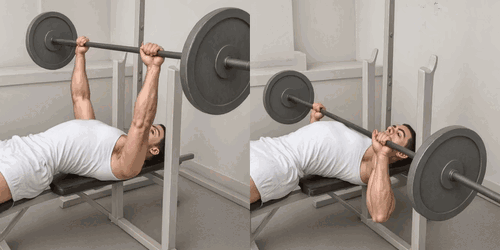

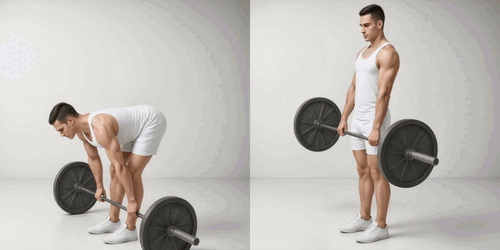


Use a workout like this 2–3 times per week if you want a simple base. Add weight, reps, or sets over time. Do not just repeat the same numbers forever and expect your body to change.
2. Cardio
Cardio burns calories. That part is obvious.
But there is a catch: your body often compensates. If you burn 400 calories during cardio, you may subconsciously move less later in the day. You still burn extra calories, just not always the full amount shown on the machine.
That is why cardio is useful, but it should not be your only fat loss tool.
Good rules:
- Do 2–4 cardio sessions per week if fat loss is a goal
- Keep most cardio easy to moderate
- Use steps as your baseline activity target
- Do not let cardio wreck your leg training
- Increase cardio gradually, not aggressively
For most lifters, cardio works best as a secondary tool. Diet sets the deficit. Strength training keeps muscle. Cardio adds extra burn and improves conditioning.
3. Daily movement
This is underrated.
Non-exercise activity can vary massively between people. Walking, standing, taking stairs, cleaning, commuting, carrying groceries, and moving around at work all count.
This is often where “fast metabolism” actually comes from. Some people simply move more all day without thinking about it.
Practical ways to increase daily burn:
- Walk 7,000–10,000 steps per day
- Take short walks after meals
- Use stairs when reasonable
- Stand up between long sitting blocks
- Park farther away
- Walk during phone calls
None of this is exciting. That is why it works. It is easy to repeat.
What might help a little
Drinking cold water
Drinking water can slightly increase calorie burn because your body warms it to body temperature. The effect is small. Think single-digit calories per glass, not hundreds.
Water can still help fat loss because it improves fullness and makes meals easier to control.
A good target for most people is about 2–3 liters per day, adjusted for body size, sweat, climate, and training. Do not force extreme water intake. More is not always better.
Spicy food
Capsaicin, the compound that gives chili peppers their heat, may slightly increase energy expenditure. But the real-world effect is small.
The bigger benefit is appetite control. Spicy meals often make people eat slower and drink more water. If that helps you eat fewer total calories, it can be useful.
Use spicy food if you like it. Do not treat it like a fat burner.
Reverse dieting
Reverse dieting means gradually increasing calories after a diet to “rebuild metabolism.”
It can help some people transition out of a fat loss phase without immediately overeating. But it is not magic. Often, the better move is to raise calories to a realistic maintenance level, monitor body weight, and adjust from there.
The key is tracking.
If body weight is stable for 2–3 weeks, you are probably near maintenance. If it rises too fast, calories are too high. If it keeps falling, calories are still below maintenance.
Simple beats dramatic.
Weighted vests
Adding load to daily movement may increase calorie burn because your body has to move more weight. This can work in theory, especially during walking.
But it is not a beginner priority.
If you use a weighted vest:
- Start light
- Use it for walks, not random all-day suffering
- Watch your knees, hips, and lower back
- Do not use it to compensate for poor diet control
It is a tool, not a shortcut.
What probably does not matter much
Green tea
Green tea may have a tiny effect on energy expenditure, but the long-term fat loss impact is not impressive.
Drink it if you like it. Do not rely on it.
Sauna
A sauna makes you sweat. Sweating is not fat loss.
You may lose water weight temporarily, but that comes back when you rehydrate. The calorie burn difference compared to sitting normally is very small.
Sauna can be useful for relaxation. It is not a meaningful metabolism strategy.
Cold exposure
Cold exposure can increase calorie burn, especially if you shiver. But short sessions usually burn very little extra.
If you enjoy cold exposure, fine. But do not confuse discomfort with fat loss progress.
Eating more meals
Eating six meals per day does not keep your metabolism “fired up” compared to three meals with the same calories.
Meal frequency should be based on hunger, schedule, digestion, and performance.
For most lifters:
- 3–5 meals per day works well
- Protein should be spread across the day
- Total calories matter more than meal timing
The biggest mistake: crash dieting
Very aggressive dieting can reduce energy expenditure. You weigh less, move less, train worse, and your body becomes more efficient.
That does not mean fat loss is impossible. It means extreme deficits are usually a bad trade.
A better target:
- Lose 0.5–1% of body weight per week
- Keep protein high
- Keep lifting heavy enough to maintain strength
- Use cardio and steps, but do not overdo them
- Take diet breaks if performance and recovery fall apart
If you weigh 90 kg, that means about 0.45–0.9 kg loss per week. Faster is not always better.
Practical rules for a better metabolism
Here is the no-fluff version.
If your goal is fat loss
Do this:
- Lift 3–5 times per week
- Track your working sets
- Eat in a moderate calorie deficit
- Hit a consistent protein target
- Walk daily
- Add cardio only as needed
- Monitor weekly body weight trends
Do not do this:
- Chase sweat
- Change your meal frequency every week
- Add endless cardio before fixing food intake
- Train with random exercises and no progression
- Expect green tea or cold water to do the work
If your goal is muscle gain
Do this:
- Train each muscle 2+ times per week
- Use progressive overload
- Eat enough to support performance
- Keep weight gain controlled
- Sleep enough
- Track strength trends
A good gaining rate for many lifters is around 0.25–0.5% of body weight per week. More than that often means unnecessary fat gain.
How Gymfile helps
You cannot manage what you do not track.
Gymfile helps you track the part of metabolism that lifters can actually influence: your training. Sets, reps, weights, routines, rest times, and muscle recovery all matter if your goal is to build muscle and keep performance high during fat loss.
With structured logging, you can see:
- Whether your lifts are progressing
- Which muscles you trained recently
- When recovery is dropping
- Whether your routine is consistent
- If you are doing enough hard work or just adding junk volume
That is more useful than guessing whether your metabolism is “slow.”
Want to make your training easier to track? Learn more at gymfile.de or download the iOS app.
Summary
You can speed up your metabolism, but not with gimmicks.
The best strategies are boring and effective:
- Build muscle
- Stay active
- Use cardio wisely
- Avoid crash diets
- Track your training
- Adjust based on real trends
Small things like cold water, spicy food, or green tea may help a little, but they are not the main driver.
If you want a better metabolism, train like someone who plans to keep muscle for years. Track your work. Progress slowly. Stay consistent.