How to Make Planks Harder and Build a Stronger Core
August 23, 2026
Holding a relaxed plank for several minutes is not the best use of your training time. Once the basic version becomes easy, improve the mechanics or choose a harder progression.
The goal is not simply to survive longer. It is to create more abdominal tension while keeping your spine and pelvis under control.
The simple answer
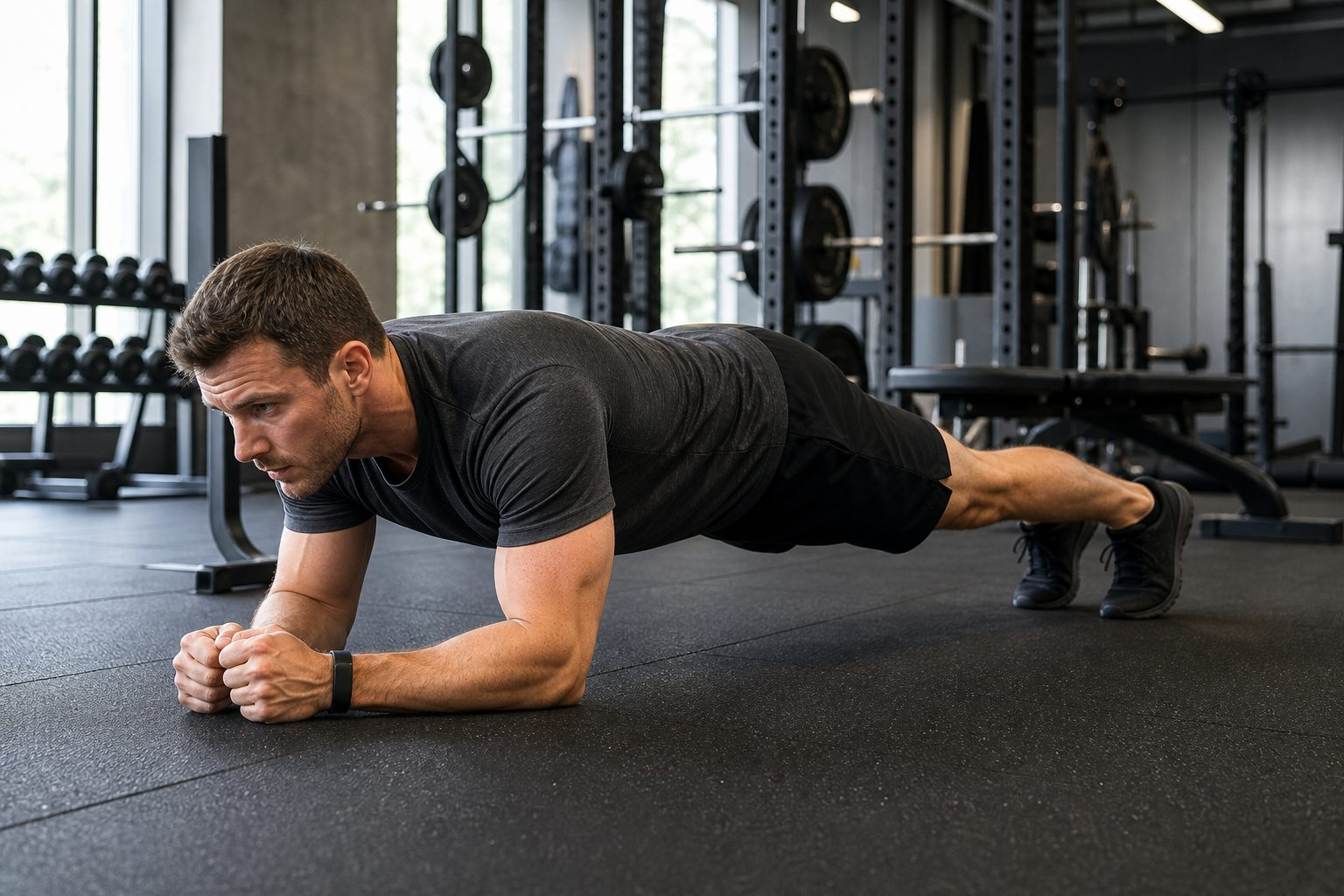
A plank trains your core to resist spinal extension. Gravity tries to pull your midsection toward the floor, while your abdominal muscles work to stop your lower back from arching.
For most lifters, a useful starting target is:
- 3 sets
- 20–40 seconds per set
- 60–90 seconds of rest
- Two or three sessions per week
Once you can complete three clean 40-second holds, do not automatically chase longer times. Make the position harder instead.
Why plank technique matters
The plank is an isometric exercise. Your abdominal muscles create tension without moving through a large range of motion.
That does not make it ineffective. Isometric core strength can help you maintain a stable trunk during squats, deadlifts, rows, presses, and loaded carries. Core endurance may also be useful when fatigue makes it harder to control your spinal position.
But the plank only works when your core is actually doing the work.
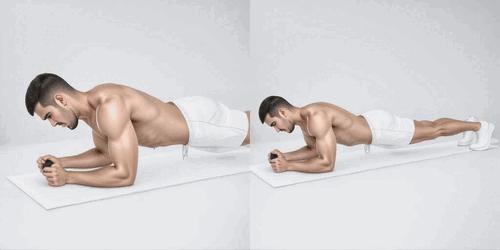
If your hips rise, the exercise becomes easier because you shorten the effective lever. If your hips sag, your lower back moves into extension and you lose the position you are supposed to resist.
A strict 20-second hold is more valuable than a loose two-minute hold.
How to perform a strict plank
Set up on a comfortable surface with your forearms on the floor.
Use these cues:
- Place your elbows under your shoulders. Your upper arms should be close to vertical in the standard version.
- Extend your legs and rise onto your toes.
- Keep your head neutral. Look at the floor rather than lifting your chin.
- Squeeze your glutes. Think about lightly tucking your pelvis instead of sticking your backside out.
- Brace your abdomen. Imagine preparing to absorb a controlled punch.
- Pull your elbows toward your toes. They should not actually move, but the intent creates more tension.
- Breathe without relaxing. Take short, controlled breaths while maintaining the brace.
End the set when you can no longer keep your hips and lower back in position. Do not extend the set by changing your posture.
A better plank progression
Progressive overload applies to core training, but adding more time is only one option. It is often the least useful one after you have developed basic endurance.
Level 1: Build a clean baseline
Start with three sets of 20 seconds. Add five seconds per set when you can hold the position without shaking excessively or losing alignment.
Work toward three sets of 40 seconds.
Level 2: Increase whole-body tension
Keep the same setup, but actively pull your elbows toward your feet and your feet toward your elbows.
Nothing should move. You are creating opposing forces through the floor.
This turns a passive hold into a much harder contraction. Your hips may naturally try to rise, so keep squeezing your glutes and hold the pelvis steady.
With strong tension, 10–20 seconds can be enough.
Level 3: Use a longer lever
Move your elbows slightly forward so they sit closer to eye level rather than directly beneath your shoulders.
This increases the distance between your support point and your hips. Your abdominal muscles must work harder to stop the lower back from extending.
Move forward gradually. A few centimeters can make a noticeable difference.
Level 4: Narrow your base
Bring your feet closer together, or position your elbows slightly closer to each other. A narrower base reduces passive stability and increases the demand on your trunk.
Only use this progression if you can keep your hips level. Instability is useful when you control it, not when it destroys your form.
Level 5: Add a dynamic progression
A rollout uses the same anti-extension pattern through a larger, moving range. As the wheel travels forward, the lever becomes longer and your core must work harder to stop your lower back from arching.
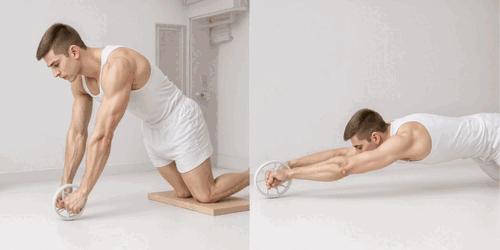
Start from your knees and use a short range of motion. Roll forward only as far as you can while maintaining a braced abdomen and controlled pelvis.
Over time, increase the distance by small amounts. Range of motion is your progression variable.
How to program the exercises
You do not need a long standalone core session. Add focused core work near the end of two or three normal workouts.
A simple structure is:
| Exercise type | Sets | Target |
|---|---|---|
| Strict plank variation | 3 | 20–40 seconds |
| Rollout progression | 2–3 | 6–12 controlled reps |
| Weighted crunch variation | 2–3 | 8–15 reps |
This combines static anti-extension work with dynamic trunk movement. For more complete core training, you can also include an anti-rotation exercise on another day.
The exact exercise mix matters less than consistent progression and good execution.
Common mistakes
Raising your hips
This shortens the lever and removes tension from the abdominal muscles.
Fix: Squeeze your glutes and lower your hips until your body forms a straight line. Do not overcorrect by letting them sag.
Letting your lower back arch
Sagging usually means the set has exceeded your current ability.
Fix: Brace harder, gently tuck your pelvis, or end the set. Shorten the hold next time.
Chasing arbitrary hold times
A five-minute plank may demonstrate endurance, but it is rarely necessary for building a stronger core.
Fix: Once 40 seconds is comfortable, increase tension, extend the lever, or move to a more demanding variation.
Holding your breath
Breath-holding can make the first few seconds feel stronger, but it limits the duration of quality work.
Fix: Maintain the brace while taking small breaths. Your abdominal wall should stay firm as you inhale and exhale.
Pulling a rollout back with your arms
The arms connect you to the wheel, but they should not dominate the return.
Fix: Keep your arms relatively fixed and initiate the return by tightening your abdomen and bringing your torso back over your knees.
Prioritizing range over control
Rolling farther is not progress if your lower back collapses.
Fix: Stop just before you lose your neutral position. Add range only when every repetition looks the same.
How to track progress
Core training becomes easier to improve when you record more than exercise names.
Track:
- variation used
- hold duration
- number of sets
- rollout repetitions
- approximate rollout distance
- rest time
- whether form stayed consistent
For planks, increase only one variable at a time. You might move the elbows farther forward while keeping the same duration, for example. Changing position, time, and rest simultaneously makes it difficult to identify real progress.
Gymfile helps you record sets, repetitions, hold times, rest periods, and exercise history in one place. That makes it easier to see whether your core training is becoming more demanding rather than merely longer.
Summary
A plank should be an active anti-extension exercise, not a waiting contest.
Start with three clean sets of 20–40 seconds. Keep your glutes tight, brace your abdomen, and maintain a controlled line from head to heels. Once that becomes easy, create more tension, lengthen the lever, narrow your base, or progress to controlled rollouts.
The standard is simple: harder mechanics with the same control. That is progressive overload your core can actually use.