Complete Pull Workout for Back and Biceps
July 14, 2026
A good pull workout needs more than a few random rows and curls. It should train your lats, upper back, traps, rear delts, and biceps without wasting sets on repeated movement patterns.
This six-exercise session does exactly that. It combines stable isolation work, vertical pulling, a heavy row, and targeted accessories in a logical order.
The workout
Start with five minutes of easy general movement. Then perform a few controlled shoulder circles, cable pull-aparts, or light pulldowns before your first working set.

Use the following targets:
| Exercise | Sets | Reps | Rest |
|---|---|---|---|
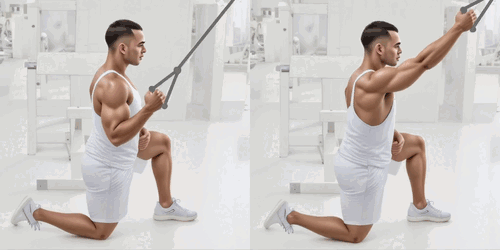
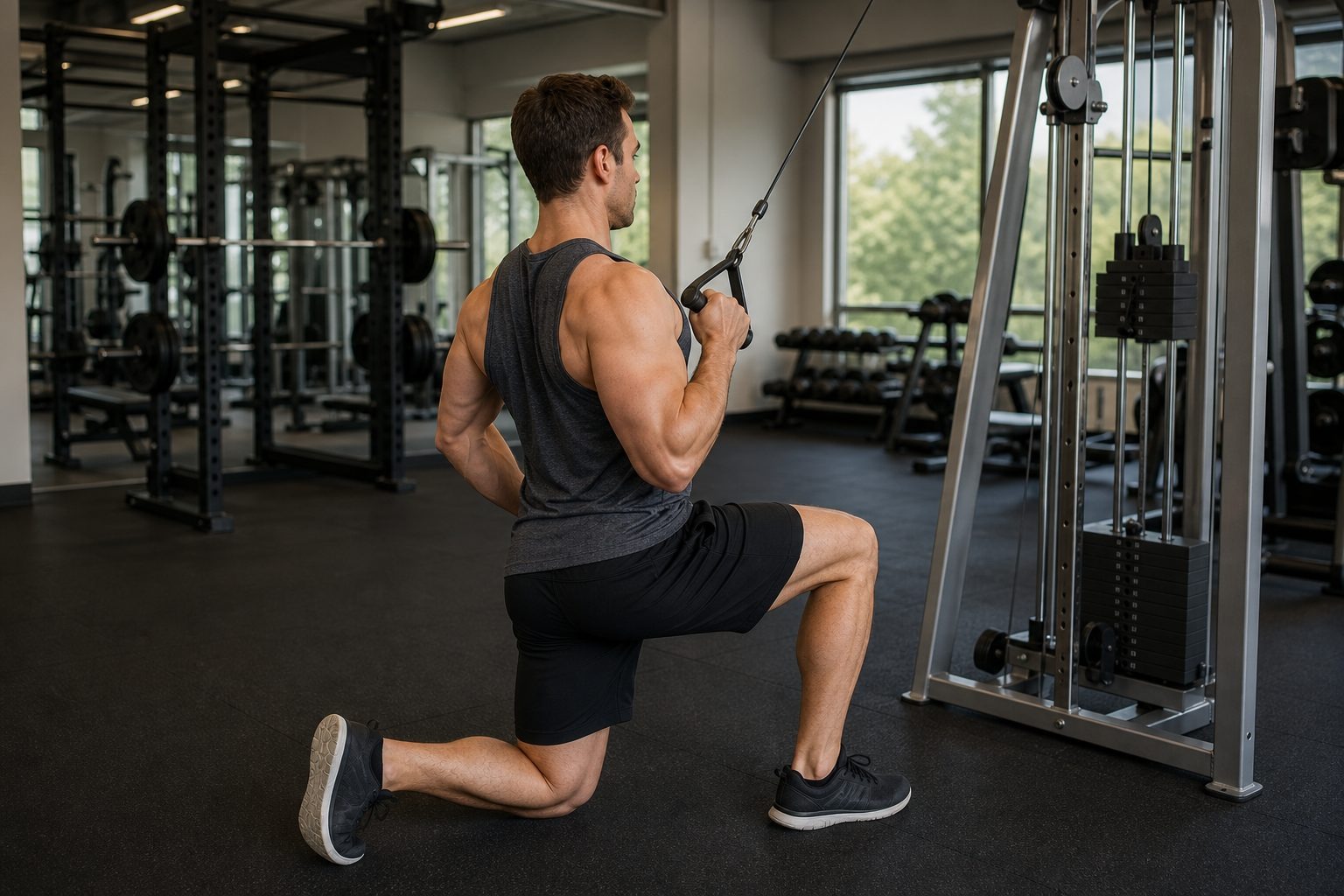
| One-arm kneeling cable lat pulldown | 3 | 12–15 per side | 60–90 seconds |
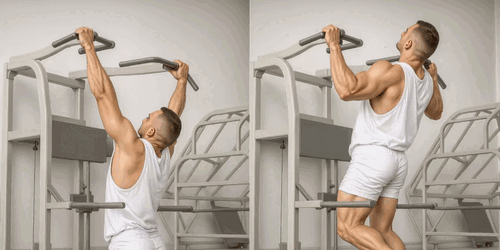
| Pull-up | 1 | As many quality reps as possible | 2–3 minutes |
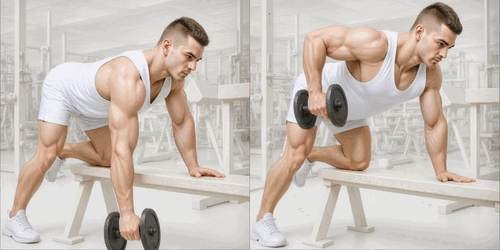
| One-arm dumbbell row | 3 | 10–12 per side | 90–120 seconds |
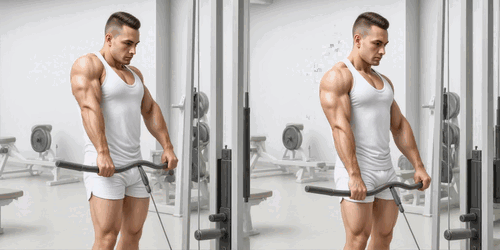
| Cable shrug | 3 | 10–12 | 60–90 seconds |
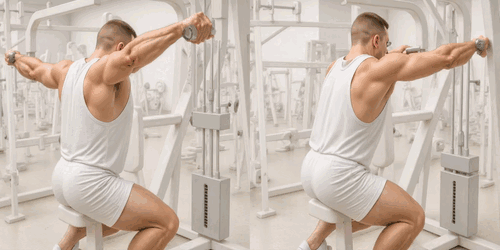
| Reverse machine shoulder fly | 3 | 10–12 | 60–90 seconds |
| Overhead cable biceps curl | 3 | 10–12 | 60–90 seconds |
Most working sets should finish with roughly one or two good reps left. The pull-up set is the exception: take it close to technical failure, ending when you can no longer complete another full rep with consistent form.
Why this pull workout works
The session covers several distinct jobs rather than relying on six similar exercises.
The kneeling pulldown trains shoulder extension with a stable base. Pull-ups provide a demanding vertical pull. The dumbbell row adds heavier horizontal pulling, while cable shrugs directly train the upper traps.
The reverse fly gives the rear delts their own focused work. Finally, the overhead curl trains the biceps from a less common arm position.
That balance matters. Compound pulling exercises involve many muscles, but larger back muscles often overpower the rear delts and biceps. A few well-chosen isolation exercises fill those gaps without turning the workout into a two-hour marathon.
1. Start with a stable lat movement
The first exercise lets you train each lat separately while fatigue is low.
Use a half-kneeling position and brace your free hand against your raised leg. Keep your ribs down and avoid rotating your torso to move the handle.
Your forearm should stay roughly in line with the cable. If the cable crosses your forearm at an awkward angle, adjust the pulley height or your distance from the machine.
Pull your elbow down toward your side, but stop when your upper arm reaches your torso. Dragging the elbow far behind your body does not create a better lat contraction. It usually shifts tension elsewhere.
Choose a load that allows 12–15 controlled reps. When you can complete 15 reps on every set without losing position, increase the weight slightly.
2. Use pull-ups as a measurable challenge
Pull-ups are difficult, which is exactly why they are useful. One hard set gives you a clear performance target without adding excessive fatigue after the pulldowns.
Use a grip slightly wider than shoulder width. Lift your chest and think about driving your elbows down and inward. Aim to bring your chin above the bar without kicking, swinging, or turning the rep into a partial.
If you cannot perform a bodyweight pull-up yet, use assistance. Pick enough help to complete approximately 6–12 clean reps.
Record the result and try to match or beat it next time. If your body weight is increasing, matching your previous reps can still represent progress because you are moving more total resistance. If your body weight is decreasing, aim to add reps or gradually reduce assistance.
3. Row hard without getting sloppy
The one-arm dumbbell row is the heaviest horizontal pull in the session.
Beginners should keep the movement strict while learning how to brace and control the weight. Once your technique is consistent, a small amount of natural torso movement is acceptable. Your body does not need to remain completely frozen.
There is an important limit: momentum may help initiate a difficult rep, but it should never remove control. Lower the dumbbell deliberately and keep tension through the negative portion.
Do not increase the load if you have to twist aggressively, shorten every rep, or drop the dumbbell from the top. Controlled movement is useful. Random movement is not.
4. Shrug up and slightly inward
Upper-trap fibers do not run perfectly vertically. With cable shrugs, think about bringing your shoulders up and slightly toward your neck rather than only lifting them straight upward.
Pause briefly at the top. Then lower your shoulders fully without rolling them forward or making circles.
Use straps if grip fatigue prevents your traps from reaching a challenging effort. Grip strength is valuable, but it should not automatically limit every back exercise.
5. Keep the reverse fly focused on rear delts
On the reverse machine fly, sweep your arms out and back in a wide arc. If you only pull the handles straight backward, the mid-back can take over.
Keep the load moderate and avoid throwing your torso into the pad. The rear delts respond better to controlled reps than to a weight you can barely move.
You can also test different hand positions:
- Palms facing each other
- Palms facing down
- Slight internal rotation, if comfortable
Individual shoulder structure matters here. Use the position that feels stable and creates the clearest rear-delt tension without joint discomfort.
6. Finish with overhead curls
The overhead cable curl places your upper arm out to the side and above shoulder level. Kneeling can make it easier to line up your arm with the cable.
Keep your upper arm still while bending your elbow. Do not turn the exercise into a pulldown or let the shoulder move forward on every rep.
This position may emphasize the biceps differently from curls performed with your arms at your sides. The effect varies between lifters, so treat it as a useful option rather than a special shortcut.
If your biceps need more weekly volume, add two sets of a standard curl later in the week instead of piling more work onto this session immediately.
How to progress the workout
Use double progression for every exercise except pull-ups:
- Begin with a load you can perform at the bottom of the rep range.
- Add reps over the following sessions.
- Increase the load once every set reaches the top of the range.
- Return to the lower end and repeat.
For example, your dumbbell row might progress from three sets of 10 to three sets of 12. Increase the dumbbell only after all three sets reach 12 with comparable technique.
Run the workout once or twice per week depending on your training split. If you perform it twice, keep at least two days between sessions and monitor elbow, shoulder, and back recovery.
Common mistakes
- Changing exercises every week: You need repeated exposure to measure progress.
- Taking every set to failure: This creates fatigue faster than it creates useful volume.
- Using the same pulling angle repeatedly: Vertical pulls, rows, and rear-delt work serve different purposes.
- Chasing a contraction at any cost: Feeling a muscle is useful, but stable technique and progression matter more.
- Using momentum without control: Slight body movement can help on heavy rows, but it should not become an excuse for careless reps.
- Ignoring assistance settings: Assisted pull-up progress only counts if you record how much assistance you used.
- Adding volume too quickly: More sets are not automatically better if performance and recovery decline.
Track what actually improves
A pull workout becomes effective when you can see whether loads, reps, assistance, and technique are improving.
Gymfile helps you record sets, reps, weights, rest times, and workout history in one place. That makes it easier to apply double progression, compare pull-up performance, and avoid guessing what you did last session.
Summary
This workout gives every major pulling muscle a clear role:
- Stable cable work for the lats
- Pull-ups for vertical pulling strength
- Heavy rows for back thickness
- Shrugs for the upper traps
- Reverse flies for the rear delts
- Overhead curls for direct biceps work
Keep the exercises consistent, stop most sets one or two reps before failure, and progress through reps before adding weight. A simple pull workout performed and tracked consistently will beat a constantly changing routine.