How to Get Visible Abs: Training, Fat Loss, and Tracking
May 27, 2026
Visible abs are not built by doing random circuits until your core burns.
You need two things: enough abdominal muscle to show, and low enough body fat for that muscle to be visible. Training matters. Nutrition matters more. Tracking makes both easier.
The simple answer
To make your abs visible, focus on three things:
- Build your abs with progressive overload.
- Lose enough body fat through a controlled calorie deficit.
- Track your training, body weight, waist, and progress photos.
For many men, abs start becoming visible somewhere around the 10–20% body fat range. For many women, the comparable range is roughly 18–28%. The exact number depends on genetics, fat distribution, and how developed your abs are.
Getting extremely lean is not required for most people. In fact, pushing too far often brings worse training performance, low energy, poor mood, hunger, and reduced libido.
The goal is not to suffer your way to the lowest possible body fat. The goal is to get lean enough while keeping strength, muscle, and a routine you can actually maintain.
Why ab training still matters
A common claim is that ab training is useless because abs only show when you are lean.
That is only half true.
Yes, if your body fat is too high, your abs will not be visible no matter how many crunches you do. But that does not mean ab training is pointless. It means ab training and fat loss solve different problems.
Fat loss reveals your abs.
Training builds the muscle that gets revealed.
You would not skip shoulder training because shoulder definition depends on being lean. The same logic applies to abs. If you train them properly, they can look thicker, sharper, and more defined once you cut down.
The problem is that most ab workouts are not built for muscle growth. Fast circuits, endless bodyweight crunches, and “fat-burning core blasts” mostly act like conditioning. They may burn some calories, but they usually do not provide enough progressive tension to build your six-pack efficiently.
Train abs like a muscle.
That means controlled reps, hard sets, enough range of motion, and progression over time.
The two main exercises you need
You do not need twelve ab exercises.
For most lifters, a simple plan built around one loaded crunch and one leg raise variation is enough.
1. Loaded crunch
A loaded crunch trains spinal flexion, which is the main function you want when trying to build the rectus abdominis — the six-pack muscle.
A good option is the cable crunch.
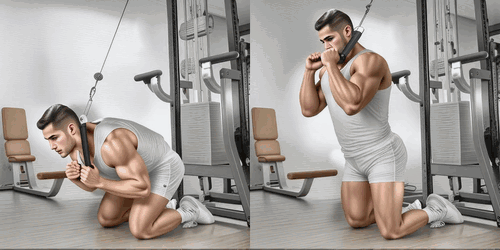
Use a rope attachment, kneel down, and crunch by bringing your ribs toward your pelvis. Let your spine round. Do not just pull the rope with your arms.
Think: abs move the weight, hands only hold the rope.
Recommended setup:
| Exercise | Sets | Reps | Frequency |
|---|---|---|---|
| Loaded cable crunch | 3 | 10–12 | 2x/week |
Take the last set close to failure, or to failure if your technique stays controlled.
Progression rule:
- If you hit the top of the rep range with good form, add a little weight next time.
- If your form breaks, stay at the same weight.
- If you feel mostly hip flexors, arms, or neck, reduce the load.
2. Leg raise
Leg raises are useful because they train the abs from a different angle and often feel more biased toward the lower part of the movement.
Good options include hanging leg raises or captain’s chair leg raises.
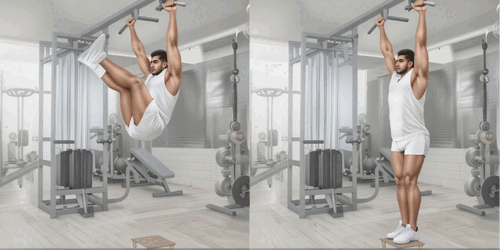
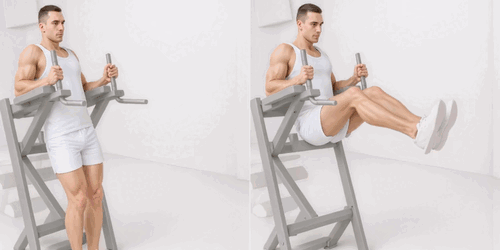
If straight-leg raises are too hard, start with bent-knee raises. They are easier to control and still effective.
Recommended setup:
| Exercise | Sets | Reps | Frequency |
|---|---|---|---|
| Leg raise variation | 3 | 10–20 | 2x/week |
Progression rule:
Start with 3 sets of 10. Add reps over time until you can do 3 sets of 20 with control. Then increase difficulty by slowing the lowering phase, using ankle weights, or moving to a harder variation.
Control matters more than height.
A sloppy leg swing is not the same as a controlled leg raise. If momentum is doing the work, your abs are getting less stimulus.
What about planks and rotation work?
Planks are useful for general core strength and stability.
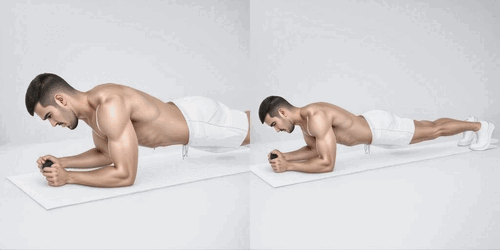
But if your main goal is visible abs, planks are not the most efficient hypertrophy tool. They are fine as an accessory, not the foundation.
Anti-rotation and oblique work can also be useful, especially for athletic training and trunk control.
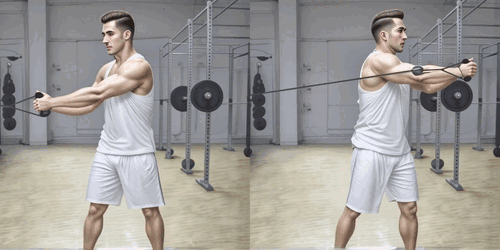
Just do not confuse them with direct six-pack training. Weighted crunches and leg raises should be the priority if the goal is to build visible abdominal muscle.
The fat loss side
You can build strong abs and still not see them if body fat is too high.
That is where nutrition becomes the main driver.
A practical starting point for fat loss:
- Calories: body weight in kg × 22–26
- Protein: goal body weight in kg × 1.8–2.2 g
- Fat: at least around 50 g per day for most people
- The rest: carbs, more protein, or more fat based on preference
Example:
If you weigh 80 kg and want to cut, a reasonable starting calorie range is:
- 80 × 22 = 1,760 kcal
- 80 × 26 = 2,080 kcal
So you might start around 1,900–2,000 kcal per day, then adjust based on results.
For protein, if your goal weight is 75 kg:
- 75 × 1.8 = 135 g
- 75 × 2.2 = 165 g
So a good daily protein target would be roughly 135–165 g.
Do not treat these numbers as magic. They are starting points. Your real progress comes from tracking and adjusting.
The right rate of fat loss
Do not crash diet.
A good target is losing about 0.5–1% of body weight per week.
If you weigh 80 kg, that means roughly 0.4–0.8 kg per week.
Faster is not always better. Aggressive dieting increases the risk of strength loss, muscle loss, poor training performance, and rebound weight gain.
If you have a long cut ahead of you, consider a diet break after several months. A simple maintenance estimate is body weight in kg × 35–40 kcal for 2–3 weeks.
This is not a free-for-all. It is a planned break from the deficit to recover mentally and physically before continuing.
Cardio helps, but it is not the main tool
Cardio is not required for fat loss. A calorie deficit is.
But cardio is still useful.
It lets you burn more calories, improve conditioning, and sometimes eat slightly more while still losing fat. It also helps many people maintain weight loss long term.
A practical target:
- 2–5 sessions per week
- 30 minutes each
- low to moderate intensity
You should finish feeling like you worked, not like you ruined your next leg day.
Common mistakes
Mistake 1: Doing only high-rep ab circuits
Burning does not automatically mean building.
If every ab workout is fast, light, and random, you are probably training endurance more than hypertrophy.
Use load. Track reps. Progress over time.
Mistake 2: Expecting ab exercises to burn belly fat
You cannot crunch fat off your stomach.
Ab training builds the muscle. Nutrition reduces the fat covering it.
Both are needed, but they do different jobs.
Mistake 3: Using the scale as the only progress marker
The scale is useful, but incomplete.
Track:
- body weight trend
- waist measurement
- monthly progress photos
- gym performance
- how clothes fit
If your waist is shrinking and strength is mostly stable, you are probably moving in the right direction even if the scale is slow.
Mistake 4: Trying to get too lean
Below a certain point, the cost rises fast.
Many lifters look good, perform well, and feel better staying in a sustainable lean range instead of chasing extreme leanness.
A visible midsection is useful.
Being miserable for slightly sharper abs usually is not.
Mistake 5: Not training abs progressively
If you use the same weight, same reps, and same effort forever, your abs have little reason to grow.
Progression does not need to be dramatic.
One extra rep, slightly more load, slower negatives, or better control all count.
Supplements that can help
Supplements are optional. They do not replace training or diet.
The useful ones are simple.
Protein powder
Protein powder is just convenient food.
Use it if it helps you hit your daily protein target. You do not need it immediately after training, but a shake after a workout can make the day easier.
Creatine monohydrate
Creatine is one of the few supplements worth taking for strength and muscle.
A simple dose is 3–5 g per day. Timing does not matter much. You do not need to cycle it.
Caffeine
Caffeine can improve focus and training performance.
Use it when it helps, not automatically every day. If you rely on it too often, tolerance builds and the effect becomes weaker.
How to apply this in your training
Here is a simple weekly setup:
| Day | Ab work |
|---|---|
| Day 1 | Cable crunch: 3×10–12 + leg raise: 3×10–20 |
| Day 2 | No direct abs |
| Day 3 | No direct abs |
| Day 4 | Cable crunch: 3×10–12 + leg raise: 3×10–20 |
| Day 5–7 | Optional plank, cardio, or rest |
Put abs after your main lifts, not before heavy squats, deadlifts, or rows.
The goal is to train them hard without interfering with the rest of your workout.
How Gymfile helps
Visible abs come from boring things done consistently: hard sets, progression, enough protein, a calorie deficit, cardio, and recovery.
Gymfile helps with the training side by letting you track your exercises, sets, reps, weights, rest times, and progress over time. You can also build ab work into your routine instead of randomly adding it when you remember.
That matters because abs respond like other muscles.
If you want them to grow, you need to know what you did last time and beat it over time.
Want to make your training easier to track? You can learn more at gymfile.de or download the iOS app here: Gymfile on the App Store.
Summary
To get visible abs, stop thinking in terms of secret exercises.
Use a simple plan:
- Train abs twice per week.
- Prioritize loaded crunches and leg raises.
- Progress reps, load, or control over time.
- Lose fat at around 0.5–1% of body weight per week.
- Eat enough protein.
- Use cardio as support, not punishment.
- Track more than just scale weight.
Abs are not built by chaos.
They are built by structure, patience, and enough consistency for your body to actually adapt.