4-Day Upper/Lower Workout Program
September 1, 2026
A four-day upper/lower split trains every major muscle group twice per week without making each session excessively long. It is a strong choice if you want a repeatable plan for building muscle and general strength.
The program below gives you four complete workouts, clear effort targets, and a simple method for progressing from week to week.

The simple answer
Complete these four workouts in order:
| Day | Session | Main emphasis |
|---|---|---|
| Monday | Upper A | Horizontal pressing and rowing |
| Tuesday | Lower A | Squat and hip hinge |
| Wednesday | Rest | Recovery or light activity |
| Thursday | Upper B | Incline pressing and vertical pulling |
| Friday | Lower B | Glutes and unilateral leg work |
| Weekend | Rest | Recovery or light activity |
The weekdays are flexible. What matters is maintaining the sequence and avoiding back-to-back upper sessions or back-to-back lower sessions when possible.
This setup usually gives each region around 72–96 hours to recover before it is trained again.
Why this split works
Training a muscle twice per week is not magic. When weekly volume is matched, frequency alone does not guarantee more muscle growth.
The real advantage is better distribution.
Instead of forcing ten hard chest sets into one session, you spread them across two workouts. That helps you maintain rep quality, technique, effort, and sensible workout duration.
This program provides moderate weekly volume:
- About 10 direct sets for the chest, back, and quadriceps
- About 8 direct sets for the hamstrings
- At least 9 challenging sets involving the glutes
- Direct shoulder, arm, calf, and abdominal work
- Additional indirect work from presses, rows, pulldowns, and lower-body compounds
For most beginner-to-intermediate lifters, this is enough work to drive progress without immediately creating a recovery problem.
The four workouts
Upper A
| Exercise | Sets | Reps | Rest | Effort |
|---|---|---|---|---|
| Barbell Bench Press | 3 | 6–8 | 2–3 min | 2 RIR |
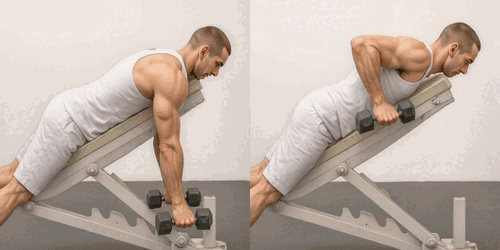
| Chest-Supported Dumbbell Row | 3 | 6–10 | 2–3 min | 2 RIR |
| Cable Lat Pull-Down | 2 | 8–12 | 2 min | 2 RIR |
| Dumbbell Shoulder Press | 2 | 8–12 | 2 min | 2 RIR |
| Machine Chest Flyes | 2 | 10–15 | 90–120 sec | 1–2 RIR |
| Cable Lateral Shoulder Raise | 2 | 12–20 | 90 sec | 1–2 RIR |
| Cable Triceps Pushdown | 2 | 10–15 | 90 sec | 1–2 RIR |
| Standing Biceps Cable Curl | 2 | 10–15 | 90 sec | 1–2 RIR |







Lower A
| Exercise | Sets | Reps | Rest | Effort |
|---|---|---|---|---|
| Barbell Squat | 3 | 6–8 | 2–3 min | 2 RIR |
| Romanian Deadlift | 3 | 6–10 | 2–3 min | 2 RIR |
| 45 Degree Machine Leg Press | 2 | 10–15 | 2–3 min | 2 RIR |
| Machine Seated Leg Curl | 2 | 10–15 | 90–120 sec | 1–2 RIR |
| Machine Standing Calf Raise | 4 | 8–15 | 90 sec | 1–2 RIR |
| Abdominal Kneeling Cable Crunch | 2 | 10–15 | 90 sec | 1–2 RIR |






Upper B
| Exercise | Sets | Reps | Rest | Effort |
|---|---|---|---|---|
| Incline Dumbbell Bench Press | 3 | 8–12 | 2–3 min | 2 RIR |
| Pull-Up | 3 | 6–10 | 2–3 min | 2 RIR |
| Seated Cable Row | 2 | 8–12 | 2 min | 2 RIR |
| Machine Chest Press | 2 | 10–15 | 2 min | 1–2 RIR |
| Reverse Machine Shoulder Flyes | 2 | 12–20 | 90 sec | 1–2 RIR |
| Cable Lateral Shoulder Raise | 2 | 12–20 | 90 sec | 1–2 RIR |
| Standing Cable Rope Overhead Triceps Extension | 2 | 10–15 | 90 sec | 1–2 RIR |
| Bicep Preacher Curl Machine | 2 | 10–15 | 90 sec | 1–2 RIR |







Lower B
| Exercise | Sets | Reps | Rest | Effort |
|---|---|---|---|---|
| Hip Thrust Machine | 3 | 8–12 | 2–3 min | 2 RIR |
| Bulgarian Split Squats | 3 | 8–12 per leg | 2–3 min | 2 RIR |
| Machine Leg Extensions | 2 | 10–15 | 90–120 sec | 1–2 RIR |
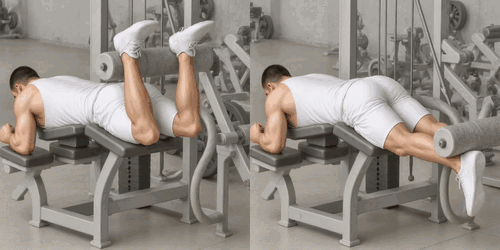
| Machine Lying Leg Curls | 3 | 8–12 | 90–120 sec | 1–2 RIR |
| Machine Seated Calf Raise | 4 | 10–15 | 90 sec | 1–2 RIR |
| Hanging Leg Raises | 2 | 8–15 | 90 sec | 1–2 RIR |





Most sessions should take around 60–80 minutes when you follow the prescribed rest periods.
How hard should you train?
Most working sets should finish with 1–3 repetitions in reserve, or RIR. Use approximately 2 RIR as your default.
| RIR | Meaning |
|---|---|
| 3 | You could perform about three more clean reps |
| 2 | You could perform about two more clean reps |
| 1 | You could perform about one more clean rep |
| 0 | You cannot complete another full rep |
You do not need to take every set to failure. Doing so creates extra fatigue and can make technique less reliable, especially on squats, presses, rows, and Romanian deadlifts.
If you use failure occasionally, reserve it for the final set of a stable machine or isolation exercise.
Choose your starting weights
Use the rep range and RIR target instead of testing maximal strength.
For an exercise prescribed as 3 sets of 8–12 at 2 RIR, choose a weight that lets you perform at least eight clean reps while stopping with roughly two reps left.
Adjust during the first week:
- Reduce the load by 5–10% if you cannot reach the minimum reps without nearing failure.
- Add a small amount of weight if the top of the range feels easy with four or more reps remaining.
- Start lighter when uncertain.
Your first week is for calibration. It does not need to produce personal records.
Progress with double progression
Add repetitions before adding weight.
For a bench press prescription of 3 sets of 6–8, progression might look like this:
| Session | Result |
|---|---|
| 1 | 70 kg: 7, 7, 6 |
| 2 | 70 kg: 8, 7, 7 |
| 3 | 70 kg: 8, 8, 8 |
| 4 | Increase the load and return toward 6 reps |
Increase the weight only after every prescribed set reaches the top of the range at the intended RIR.
Use small jumps:
- Around 1–2.5 kg total for upper-body exercises
- Around 2.5–5 kg total for lower-body exercises
- The next available increment on machines
If the next jump is too large, keep the current load and build more controlled reps.
Warm up without wasting energy
A warm-up should prepare you, not fatigue you.
Before the first major exercise:
- Perform 3–5 minutes of easy movement if you feel cold or stiff.
- Use any dynamic movements that help the relevant joints feel ready.
- Complete several progressively heavier exercise-specific sets.
For a compound lift, begin with a light set of 10–15 reps. Increase the load over two or three additional sets while reducing the reps. Your final warm-up might be only one to three reps below the working weight.
Warm-up sets do not count as working sets. Later exercises usually need only one or two lighter preparation sets.
Common mistakes
Resting too little
Hard compound sets need two to three minutes. Short rest periods may make training feel intense, but they can reduce performance without improving the stimulus.
Turning every set into failure training
Your RIR target should not slowly become zero on every set. If performance keeps dropping, check your effort before adding more volume.
Changing exercises every week
Keep the main exercises stable for at least six to eight weeks. Constant variation makes progression difficult to measure.
Adding sets at the first plateau
One poor session is not a programming emergency. Keep the load, restore your reps, check your rest periods, and assess recovery first.
Compensating for missed workouts
Do not combine two complete sessions or double your sets. Continue the sequence from the workout you missed.
Adjust for recovery
If several exercises decline at once and sleep, stress, travel, or other activity has been unusually demanding, reduce training stress for that week.
A practical adjustment is to:
- Remove one set from each exercise
- Keep 3–4 RIR
- Avoid failure
- Use slightly lighter loads if necessary
A deload is useful when fatigue and declining performance persist together. It does not need to happen automatically every fourth week.
For a simple deload, reduce working sets by about half for one week, keep 3–4 RIR, and stop trying to progress temporarily.
How Gymfile helps
This program only works if you know what you did last time. Record your sets, repetitions, weights, effort, and rest periods instead of relying on memory.
Gymfile helps you keep the four workouts organized and see whether performance is actually improving. That makes double progression straightforward and helps separate a genuine plateau from one random bad session.
Summary
A four-day upper/lower split is effective because it distributes useful training volume across manageable sessions.
Follow these rules:
- Complete the workouts in sequence.
- Train mostly at 1–3 RIR.
- Rest long enough to maintain performance.
- Add reps before increasing weight.
- Keep exercises consistent for six to eight weeks.
- Reduce training stress when recovery clearly worsens.
- Never compensate aggressively for one missed workout.
The split itself is only the structure. Consistent execution, sufficient effort, recovery, and measurable progression are what produce results.