Can You Build Muscle and Lose Fat at the Same Time?
May 27, 2026
Yes, you can build muscle and lose fat at the same time.
It is not magic. It is not only for beginners. But it does require the right setup: hard training, enough protein, controlled calories, good sleep, and consistent tracking.
The simple answer
Body recomposition means gaining muscle while losing fat.
For many lifters, it is realistic. Especially if you are:
- new to serious strength training
- returning after a break
- overweight or carrying extra body fat
- training consistently but not very effectively yet
- eating better than before
- finally tracking your workouts properly
The only people who should expect very slow recomposition are highly advanced lifters who are already lean, strong, consistent, and close to their natural muscle-building limit.
That is a small group.
Most people in a normal gym still have plenty of room to improve their training, nutrition, recovery, or consistency. That means recomposition is possible.
Why recomposition works
Muscle and fat are not the same tissue.
You do not need to gain fat in order to build muscle. You need a strong enough training stimulus, enough protein, enough recovery, and enough available energy.
That energy can come from food. But if you already carry body fat, some of it can also come from stored energy.
This is why a beginner with extra body fat can often build muscle in a calorie deficit. Their body has plenty of stored energy, and the training stimulus is new enough to drive muscle growth.
But the more advanced and lean you are, the harder this becomes.
At that point, building muscle usually works better around maintenance calories or with a small surplus.
Training is the main driver
Nutrition matters, but training is the engine.
You can eat perfectly and still build very little muscle if your training is weak. Recomposition needs progressive resistance training.
Focus on:
- hard sets close to failure
- good technique
- enough weekly volume
- repeatable exercises
- progressive overload over time
For most lifters, a useful starting point is 10–20 hard sets per muscle group per week.
Start closer to 10 if you are newer, busy, cutting, or recovering poorly. Move toward 15–20 only if you are progressing and recovering well.
More volume is not automatically better. Junk volume still counts as fatigue.
Pick your primary goal
You can aim for both muscle gain and fat loss, but one should be the priority.
If you are already lean, make muscle gain the priority.
For example:
- men around 8–12% body fat
- women around 18–22% body fat
In that case, use maintenance calories or a small surplus.
If you have more fat to lose, make fat loss the priority.
For example:
- men around 15–20%+ body fat
- women around 25–30%+ body fat
In that case, use a small to moderate deficit while keeping training performance as high as possible.
This avoids the common mistake of trying to diet aggressively and gain muscle fast at the same time.
Set calories around maintenance
Maintenance calories are the center point.
From there:
| Primary goal | Calorie target |
|---|---|
| Build muscle while staying lean | Maintenance to 5–15% surplus |
| Lose fat while gaining/keeping muscle | 10–20% deficit |
| Beginner with higher body fat | 10–20% deficit is usually fine |
| Lean intermediate lifter | Maintenance or small surplus is usually better |
A huge surplus is not required for muscle gain.
A big bulk may increase scale weight faster, but a lot of that extra weight can be fat. If your goal is a better physique, not just a heavier body, the surplus should be controlled.
A good lean-gain rate is slow:
- around 0.25–0.5% of body weight per week when gaining
- around 0.5–1% of body weight per week when losing fat
If you are gaining faster than that, you are probably adding unnecessary fat.
Protein matters a lot
Protein is the most important macro for recomposition.
A good target for most lifters is:
- 1.6–2.2 g protein per kg body weight per day
- up to 2.2–2.7 g/kg if you are lean, dieting, or very hungry
For a 75 kg lifter, that means roughly:
- 120–165 g per day for most situations
- up to about 200 g if dieting hard and already lean
You do not need perfect timing. But it helps to spread protein across the day.
A simple setup:
- 3–5 protein meals per day
- 25–50 g protein per meal
- protein before or after training
- a slow-digesting protein meal before bed if it fits your routine
Protein powder is not special. It is just convenient. Use it if it helps you hit the target.
Do not slash fats too low
Fat intake should not be pushed to zero.
A practical minimum is around 20% of total calories.
After protein and fat are set, fill the rest with carbs.
Carbs are useful because they support training performance. Better training performance usually means better muscle retention and growth.
So if you lift hard, do not be afraid of carbs. Put more of them around your workouts if that helps you train better.
Useful exercises for recomposition
The best exercises are the ones you can perform well, progress over time, and recover from.
Use a mix of stable compounds and targeted accessories.
| Exercise | Why it helps |
|---|---|
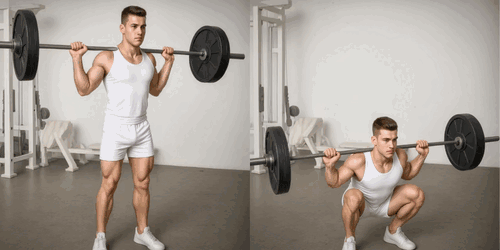 |
Big lower-body stimulus, easy to track progression |
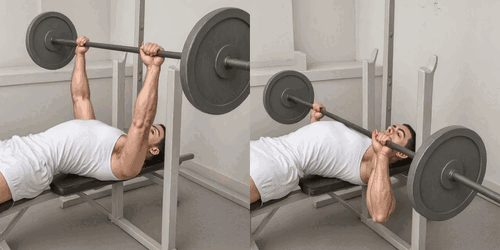 |
Strong chest, shoulders, and triceps builder |
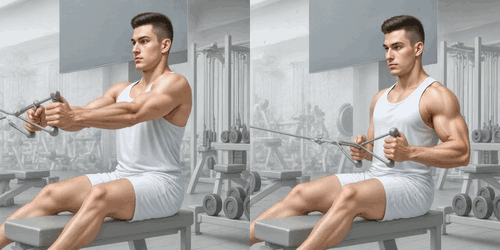 |
Stable back exercise with good progression potential |
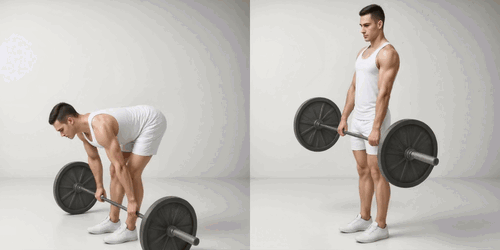 |
Great for hamstrings, glutes, and posterior chain |
 |
Good vertical pull for lats and upper back |
 |
Builds shoulders with a natural range of motion |
These are not mandatory exercises. They are examples of trackable movements that make progression easier.
Common mistakes
Cutting too aggressively
If the deficit is too large, training performance drops.
That makes muscle gain harder and muscle loss more likely.
A moderate deficit is usually better for recomposition than a crash diet.
Bulking too hard
A large surplus can make you stronger faster, but it also increases fat gain.
If you do not want to spend months cutting later, keep the surplus small.
Changing routines too often
Recomposition requires comparison.
If you change exercises every week, you cannot tell if you are actually progressing.
Keep your main lifts stable for at least 6–10 weeks.
Training without enough effort
Recomposition does not happen from easy sets.
Most working sets should land within about 0–3 reps from failure, especially on safer machine, cable, and isolation exercises.
You do not need to max out constantly. But the sets need to be hard enough to matter.
Ignoring sleep
Sleep affects hunger, performance, recovery, and body composition.
If you sleep badly, you can still lose weight, but more of that weight may come from lean mass instead of fat.
Aim for 7–9 hours when possible. If that is unrealistic, at least keep sleep consistent and avoid making poor sleep your normal baseline.
Supplements that can help
Supplements do not cause recomposition by themselves.
But a few are useful:
- Creatine monohydrate: 3–5 g per day
- Protein powder: useful when food protein is not enough
- Caffeine: useful before hard sessions, but tolerance builds
Do not overcomplicate this. Creatine, protein, and caffeine cover most of the useful ground.
How to apply it in your training
Use this simple setup:
- Pick your main goal: fat loss or muscle gain.
- Set calories around maintenance.
- Eat enough protein every day.
- Train each muscle with 10–20 hard sets per week.
- Keep exercises stable long enough to track progress.
- Add weight, reps, or better control over time.
- Sleep enough to recover.
- Adjust based on real data, not feelings.
Track at least:
- body weight trend
- workout performance
- sets, reps, and weights
- muscle measurements or progress photos
- recovery and soreness
If weight is dropping but lifts are stable or improving, you are probably recomping well.
If weight is rising slowly and waist size is stable, you may also be recomping.
If weight is rising fast and waist size jumps, your surplus is probably too high.
How Gymfile helps
Gymfile makes recomposition easier because it keeps the important data in one place.
You can track your sets, reps, weights, rest times, routines, and progress over time. You can also see which muscles you trained recently and use recovery information to make better decisions instead of guessing.
That matters because recomposition is slow.
You may not see dramatic changes every week. But if your lifts are moving up, your body weight is controlled, and your routine is consistent, you are probably moving in the right direction.
Want to make this easier? Gymfile helps you track workouts, monitor progress, and structure your training without relying on memory.
You can also download Gymfile for iOS.
Summary
You can build muscle and lose fat at the same time.
For most lifters, recomposition is realistic when training, nutrition, and recovery improve together.
The key points:
- train hard with progressive overload
- eat enough protein
- stay near maintenance, in a small surplus, or in a moderate deficit
- avoid crash dieting and dirty bulking
- sleep enough
- track your workouts and bodyweight trends
- stay consistent long enough to see changes
Recomposition is not the fastest way to maximize muscle gain. It is not the fastest way to maximize fat loss.
But for many people, it is the smartest way to build a better physique without unnecessary fat gain.